

Why Sydney Backyards Flood and the Fixes That Last
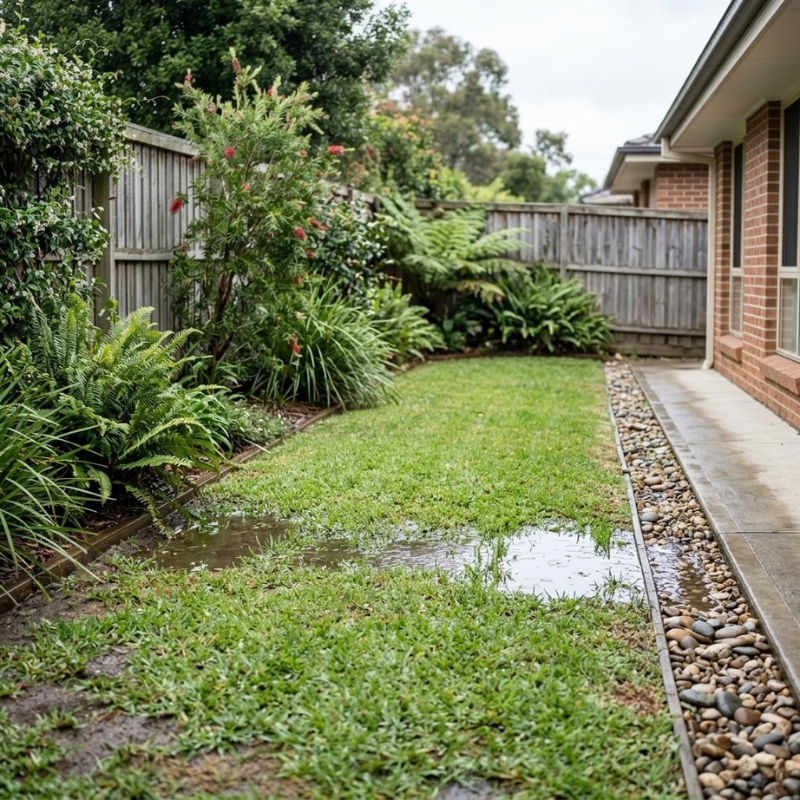
You know the patch. Days after the rain has stopped and the street has dried out, one corner of the lawn is still soft underfoot, the grass a darker green, a faint smell of wet earth when you walk across it. If that is your backyard, the cause is almost always one of four things, and this article names all four. The good news is you can usually work out which one you have got without digging up a thing. A Bargain Gardener sorts out garden drainage for homeowners right across Sydney, and the same handful of causes come up again and again. Here is how to tell them apart, and what genuinely fixes each one for good rather than until the next big downpour.
Four reasons water sits in a Sydney backyard
Standing water in a Sydney yard nearly always traces back to one of four culprits: the soil itself cannot drain, the ground slopes the wrong way, a downpipe is dumping stormwater straight into the garden, or an old drainage line underground has given up. Often it is a combination, but there is usually a main offender. Each one leaves its own telltale signs, and each has its own proper fix, so it is worth knowing which you are dealing with before you spend a dollar.
Why does water pool in my garden when the soil is clay?
If water sits on the surface for a day or more and the ground underneath feels dense and sticky, you are almost certainly on clay, and clay is the most common drainage culprit across Sydney. Much of the Sydney basin sits on clay-heavy soils, mapped in the NSW Soil Landscape Resources, and clay holds water rather than letting it soak away.
The reason is simple enough. Clay particles are tiny and pack together tightly, leaving very little space between them for water to move through. So rain that would vanish into sandy soil instead perches on top of the clay and sits there until it evaporates or finds somewhere to run. There is an easy test. Dig a hole about 30cm deep, fill it with water, let it drain, then fill it again and watch. If the second fill is still sitting there hours later, your soil is the problem. You can also drop a scoop of soil in a jar of water and shake it. Clay settles slowly and leaves the water cloudy for ages.
Does my backyard slope towards the house?
If the wettest ground is close to the house rather than down the back, the fall is probably working against you, and this is the one to take most seriously. Ground should always slope away from a building so water runs off, and when it slopes back towards the slab instead, that water pools against the foundations where it can cause real damage over time.
Fall is just the gentle slope of the ground, and over the years it drifts. Garden beds get built up, soil settles, a path gets added, and suddenly the yard tips the wrong way without anyone deciding it should. Checking it is low-tech. Lay a length of hose or a straight board across the ground running away from the house, rest a spirit level on it, and see which way the bubble leans. If the ground rises as it leaves the building, or sits dead flat, water has nowhere to go. This one matters more than the others because it is not just your lawn at stake; it is the house, and poor fall near the slab is worth acting on sooner rather than later.
Where does the water from my downpipes go?
Walk out in the rain and look at the base of each downpipe. If water is gushing straight out onto the garden or into a pit that fills and overflows, your stormwater is not connected, and a single downpipe can put an enormous volume of water into one small patch during a storm.
A downpipe that empties onto the ground is doing exactly what it should not. All the water the roof collects, which is a lot, gets concentrated into one spot and sent into the soil right there. Look for a downpipe that just stops a few centimetres above the dirt, or one feeding a pit that clearly cannot cope. If the boggiest part of the yard happens to sit right below a downpipe, you have very likely found your answer, and this is often the cheapest of the four to put right.
Why has my old garden drain stopped working?
If your yard used to cope with rain and has slowly got worse, there may be an agricultural drainage line underground that has silted up or collapsed. An ag line is a perforated pipe laid in gravel that carries water away beneath the surface, and like anything buried, it does not last forever.
Over years, fine soil and silt wash into the gravel and slowly choke it, or tree roots find the pipe and crack it, or a section simply caves in. The drain is still there, it just is not moving water any more. The signs are a yard that has quietly deteriorated season by season, water surfacing in a line rather than a puddle, or a spot that stays wet long after everywhere else has dried. If you know a previous owner put drainage in and it is no longer doing its job, this is the likely reason.
How to tell which one you have
You can narrow it down in an afternoon, no digging required. Watch where the water sits, how long it lingers, and whether it is worse near the house or down the back, then match the pattern below.
| What you notice | Most likely cause |
| Water sits for a day or more, soil is sticky and dense | Clay soil that cannot drain |
| Wettest ground is right against the house | The fall runs towards the building |
| Boggy patch sits directly under a downpipe | Stormwater discharging into the garden |
| Yard has slowly got worse over several seasons | An old ag line that has silted or collapsed |
| Water surfaces in a line rather than a pool | A failed or collapsed underground drain |
| Whole yard is slow to drain, sandy patches aside | Clay, often combined with poor fall |
Most yards show more than one of these, and that is normal. Find the dominant pattern first, because that is the one driving the problem, and solving it often takes care of the smaller contributors along with it.
The fixes, and when each one is worth it
Once you know the cause, the right fix tends to pick itself. Here is what each option does and the situation it suits.
A surface drain, the long grated channel you see set into paving and paths, catches water running across a hard surface before it reaches the lawn or the house. It is the fix when water sheets off a patio or driveway and pools where it lands.
An ag line is the underground answer for a yard that holds water across a broad area. The perforated pipe sits in a gravel-filled trench and collects water from the surrounding soil, carrying it off to a legal discharge point. This is the workhorse fix for clay blocks that stay soggy all over.
Regrading reshapes the ground itself so it falls away from the house the way it should. It is the right call when the fall is the core problem, and because it involves reshaping levels properly around the building, it is usually handled as part of broader landscaping across Sydney rather than a quick patch job.
A soakwell is an underground chamber that takes concentrated water, often from a downpipe, and lets it soak away slowly into the surrounding ground. It suits a site where stormwater needs somewhere to go and the soil below has enough capacity to take it.
A dry creek bed is a shallow stone-lined channel that guides surface water along a planned route while looking like a garden feature rather than a drain. It works where you want to move water across a slope and would rather it looked intentional than industrial.
What you can do yourself and what needs a professional
Some of this is a fair weekend job, and some of it really is not. Clearing a blocked grate, scooping the silt out of a pit, or redirecting a downpipe so it empties somewhere sensible are all reasonable DIY fixes, and worth doing before you call anyone, because they sometimes solve the whole thing.
Where it stops being a DIY job is anything involving fall near the building or connecting into the stormwater system. Getting the fall wrong around a slab can send water towards the foundations instead of away, which is worse than doing nothing, and stormwater connections have rules about where water can legally discharge. That is the point of bringing in someone who does it properly. If the cause turns out to be the soil or the fall rather than a quick surface fix, professional garden drainage solutions in Sydney will sort the underlying problem rather than just moving the puddle a few metres.
Getting your backyard back
If the wet patch is not clearing on its own after a season or two, it is not going to, and the next step is having someone look at the fall and the soil on site to pin down the real cause. A yard that has been boggy for months often needs the lawn repaired once the drainage is sorted, which is where fresh turf laying in Sydney comes in to finish the job and give you back a backyard you can actually use.